Monday, December 16, 2019


A VANISHING DISEASE:
GENERAL PARESIS


Guy de Maupassant (Wikipedia)
    On January 1, 1892, the famous French writer Guy de Maupassant, in a delirious state, pointed a revolver at himself and pulled the trigger. He heard only a click, however, as his valet, worried about his mental condition, had earlier removed the bullets. Maupassant then stabbed himself superficially and attempted to jump out a window before his valet rescued him. Committed to an asylum, Maupassant’s delusions and irascible behavior intensified and, in July of 1893, after a series of convulsions, he finally met his end. He was 43 years old. His brother had met a similar fate not long before.
    Years earlier, Maupassant proudly announced that he had syphilis, undoubtedly related to his frequent brothel visits. By the late 1880s, he was becoming irritable and complaining of pains in his stomach, head, and elsewhere, preludes to his later sufferings. His final years were almost certainly due to a late stage of syphilis, known as general paresis, characterized by delusions, dementia, weakening or paralysis of various motor functions, and eventually death.
   At the onset of the nineteenth century even the notion that brain disease could cause mental illness, rather than the other way around, was unclear. A Parisian medical student, Antoine Bayle, in his doctoral thesis of 1822, explored the issue with a path-breaking doctoral thesis. He noted that since so many autopsies in mentally ill patients had shown no brain pathology, theories had arisen placing the seat of “madness” in other organs. Bayle then described six cases from the Charenton Insane Asylum, near Paris (where the Marquis de Sade had been confined), who had progressed from delusions of grandeur to weakness, dementia, and death. In all cases, he found inflammation of the tissues covering the brain and attributed the mental disturbances to the inflammatory changes. Not long after, Bayle published on over 200 similar cases and other authors made similar reports, all boosting the theory of organic/structural causes for mental illness.
Alzheimer's drawing of involved areas in general paresis (Hist u Histopath Arbeiten v1,1904, Hathi Trust)
     Alois Alzheimer, the pathologist who described the brain changes seen in dementia, published, in 1904, detailed findings in the brains of paretics, locating the primary damage in the frontal lobes and meningeal coverings. Franz Nissl, another noted neuropathologist and a friend, published similar findings in the same journal issue. By this time general paresis accounted for about 10 to 30 percent of psychiatric admissions. A relation to syphilis was considered probable, though with no organism to point to debate was still vigorous. William Osler, in his 1892 text, acknowledged a relationship to syphilis but felt that in the U.S. the hectic pace of modern life was a major factor causing general paresis, along with alcoholism and lead poisoning. 
   Events accelerated the following year when Fritz Shaudinn finally sighted the tiny spiral-shaped organism, now called treponema pallidum, in a secondary syphilis papule. The next year the Wassermann reaction for syphilis was published, a valuable diagnostic tool. Yet another year later, Paul Ehrlich announced the first “magic bullet”, an arsenical, to treat syphilis. Finally, in 1912 Hideyo Noguchi at the Rockefeller Institute discovered the treponema in the brain and spinal cord of patients. Doubts disappeared on the cause of general paresis, though arguments on organic vs psychologic origins for other mental illnesses carried on. 
Julius Wagner-Jauregg (Wikipedia)
    Therapy remained a problem. Arsenicals were toxic and required a long, painful series of injections. Further, the drugs penetrated poorly into brain tissue. Some patients with general paresis, however, unexpectedly improved after surviving an infection, raising the question: could fever weaken the organism? An Austrian psychiatrist, Julius Wagner von Jauregg, cautiously investigated the effects of fever. Starting with tuberculin injections, he turned to malaria infection and saw improvement in a substantial number of paretics. Eventually, malaria therapy - infusing patients with the safer vivax strains - became widespread. A variety of heating devices also sprang up to duplicate the effects of malaria. The results impressed the scientific world enough to award a Nobel Pirze to Wagner-Jauregg. The treatments, however, were only a partial solution. They often produced remissions rather than cures and worked best in early cases. 
Al Capone (Wikipedia)
    A patient that suffered through the full gamut of ministrations was the notorious gangster, Al Capone. Probably contracting the disease in his teens, mental symptoms were first apparent in the Atlanta Penitentiary, where he was sent for tax evasion at age 33. Boasting extravagant exploits, he was diagnosed with megalomania due to central nervous system syphilis, confirmed with blood and spinal fluid tests. Bismuth (another heavy metal) therapy was begun. Two years later, this time in Alcatraz, his megalomania worsened and he received arsenicals and more bismuth. Near the end of his prison term he was transferred to the care of Dr. J. E. Moore, a world expert on venereal disease at Johns Hopkins Hospital. Capone was admitted under an assumed name and treated with malaria infections and possibly more heavy metal. The trustees of Johns Hopkins Hospital and a second hospital, learning the identity of their patient, both forced him to leave, so his family rented a house in Baltimore to finish treatments. To follow the results of therapy, repeated spinal taps were done under the watchful eye of Capone’s bodyguards.       
     In March 1940, Capone moved to his house on Palm Island, Florida, now a weak man, demented, a shell of his former self. He seemed to stabilize, grew fat, but did not improve mentally. In 1945 he was given penicillin, one of the first to receive it, but it did little good and in January 1947, after suffering a “stroke” he died quietly. 
    The former scourge of syphilis is today under better control and
 general paresis, the late stage of brain involvement, is rare. At an earlier time, however, general paresis was important in the evolution of psychiatric ideas and in the early development of therapy of infectious diseases before the modern “magic bullets”.

 And now to a lighter subject: HAPPY HOLIDAYS TO ALL AND A HAPPY NEW YEAR!

SOURCES:
Ropper, A H and Burrell, B D. How the Brain Lost its Mind: Sex, Hysteria, and the Riddle of Mental Illness. 2019; Avery Press.
Lerner, M G. Maupassant. 1975; George Allen & Unwin.
Hayden, D. Pox: Genius, Madness, and the Mysteries of Syphilis. 2003; Basic Books.
Solomon, H C. “General Paresis: What It Is and its Therapeutic Possibilities”. 1923; Amer J Psych 79: 623-46.
Whitrow, M. “Wagner-Jauregg and Fever Therapy” 1990; Medical History 34: 294-310.
A. J. K. “Joseph Early Moore” (obituary). 1958; Brit J Vener Dis 34: 58.
Moore, M and Solomon, H C. “Contributions of Haslam, Bayle, and Esmarch and Jessen to the History of Neurosyphilis”. 1934; Arch Neurol Psychiat. 32: 804-39.
Bergreen, L. Capone: The Man and the Era. 1994; Simon & Shuster.


Wednesday, November 13, 2019

MESMER AND ANIMAL MAGNETISM


     In 1778 a German doctor, Franz Anton Mesmer, educated at the University of Vienna Medical School, left his practice in Vienna after being shunned by a hostile medical faculty. His work as a healer using a new therapy, animal magnetism, based on an invisible fluid that permeated the universe and whose passage through the body was 
F. Anton Mesmer (Wikipedia)
essential for good health, was considered chicanery by the academic community. Chased also by rumors of inappropriate sexual behavior, he moved to Paris and opened a new practice in a fashionable area. 
   Animal magnetism did not sound outlandish to many French Enlightenment Parisians. Writings by Voltaire on Isaac Newton’s gravity, describing it as the effects of an invisible “fluid”, pervading the universe, were popular. Similar was electricity, another 
Voltaire at work (Wellcome Library)
mysterious fluid with a variety of uses, including treatment of illness. Magnetic attraction resembled gravity, and phlogiston, an invisible substance responsible for heat, still permeated scientific thought. Balloons filled with “dephlogisticated air” (hydrogen) ascended to extraordinary heights. Theories of immaterial “vitalistic” forces abounded in medical writing. Mesmer’s technique of restoring patients to health by aiding the flow of magnetic fluid through the body sounded quite reasonable to many.    
     For official recognition of his method Mesmer appealed to the French Academy of Sciences, the Royal Society of Medicine, and the Paris Faculty of Medicine. All refused to endorse him. Charles Deslon, however, a Paris Faculty member and physician to the brother of Louis VI (who later ruled France as Charles X), became a believer and adopted Mesmer’s techniques. 
         The demand for treatment was high, forcing Mesmer to conduct group therapy sessions. Patients were seated around a central tub, about a foot high, partly filled with glass and iron filings and covered in wood. Ropes around the patients’ waists transmitted the fluid from one to another, as did the linking of hands. Iron bars protruded from the barrel, angled to touch parts of the body to receive the magnetic fluid.  Attendants also touched various parts needing treatment with iron rods or pressed with their hands on the upper abdomen (and sometimes the lower part) to impart more fluid.
Patients around the barrel. No ropes in this image. Attendant on left pressing on abdomen. Notice mirrors.
(Wellcome Library)
     In individual sessions the therapist sat with his knees touching the patient’s as he pressed on various parts of the abdomen. The light was dimmed and a musical instrument, usually a glass armonica, invented by Benjamin Franklin, 
Glass harmonica. Rubbing the fingers on the edges of the
rotating wet glass discs produces the notes (Wikipedia)
produced soft, ethereal sounds. Mirrors around the room reflected back any escaping magnetic fluid. Before long subjects began trembling or shouting and progressed to seizures and other movements. Those with the most violent movements were moved to a room with padded walls. Inducing such a “crisis” was thought important to a cure. 
Another Version. The woman in the back is carried into the padded room (Wellcome Library)
(Click on image for enlargement)

     Mesmer formed a secret society, the Society of Harmony, to initiate new practitioners, for which he charged a substantial admission fee. But there were many detractors, ridiculing the methods. Especially noted was that most of the subjects experiencing crises were women.
    
Single patient (Wellcome Library)
 The controversy for and against mesmerism was so intense that King Louis XVI established a royal commission to investigate. It consisted of five members of the Academy of Sciences and four from the Faculty of Medicine. Prominent members included the chemist Lavoisier, Bailly (a famous astronomer), Dr. Guillotin (for whom the beheading instrument was named), and the famous botanist Laurent de Jussieu. Benjamin Franklin, the most famous of all, headed the commission. A second commission filing a secret report included five from the Royal Society of Medicine. 
Benjamin Franklin, by Joseph Duplessis
(Wikipedia)
     Mesmer refused to cooperate with the commission unless they considered long-term results, which they declined to do. Mesmer and his chief disciple, Deslon, however, had separated. Deslon, already magnetized, knew the technique and had established his own practice, so the commission turned to him to magnetize subjects. 
     The commissioners understood that “cures” could be spontaneous, unrelated to treatment, and focused their attention on establishing whether the “fluid” existed or could be detected by “sensitive” patients. Both commission members and patients were tested. The commissioners, when magnetized, felt nothing. Subjects, when blindfolded and asked to touch objects that might or might not be magnetized, failed to detect anything accurately. 
    After many trials, often at Benjamin Franklin’s residence in Passy, a Paris suburb, the commission concluded that the “cures” could only be attributed to patient suggestion and that there was no evidence of a mysterious “fluid”. The commission wrote “…that the imagination without the magnetism produces convulsions, and that the magnetism without the imagination produces nothing; they have concluded…that the existence of the fluid is absolutely destitute of proof, that the fluid having no existence can consequently have no use…” The second, “secret”, report for the King’s eyes, by the Royal Academy of Medicine, suggested that the various touchings during the process may have awakened sexual desires in the mostly female subjects, and indicated that women were more susceptible to suggestion. Definitely a male point of view. 
   After the report Mesmer’s influence waned. As the revolution approached, he traveled to Switzerland and Germany, partly to visit family, and ended his days in obscurity.
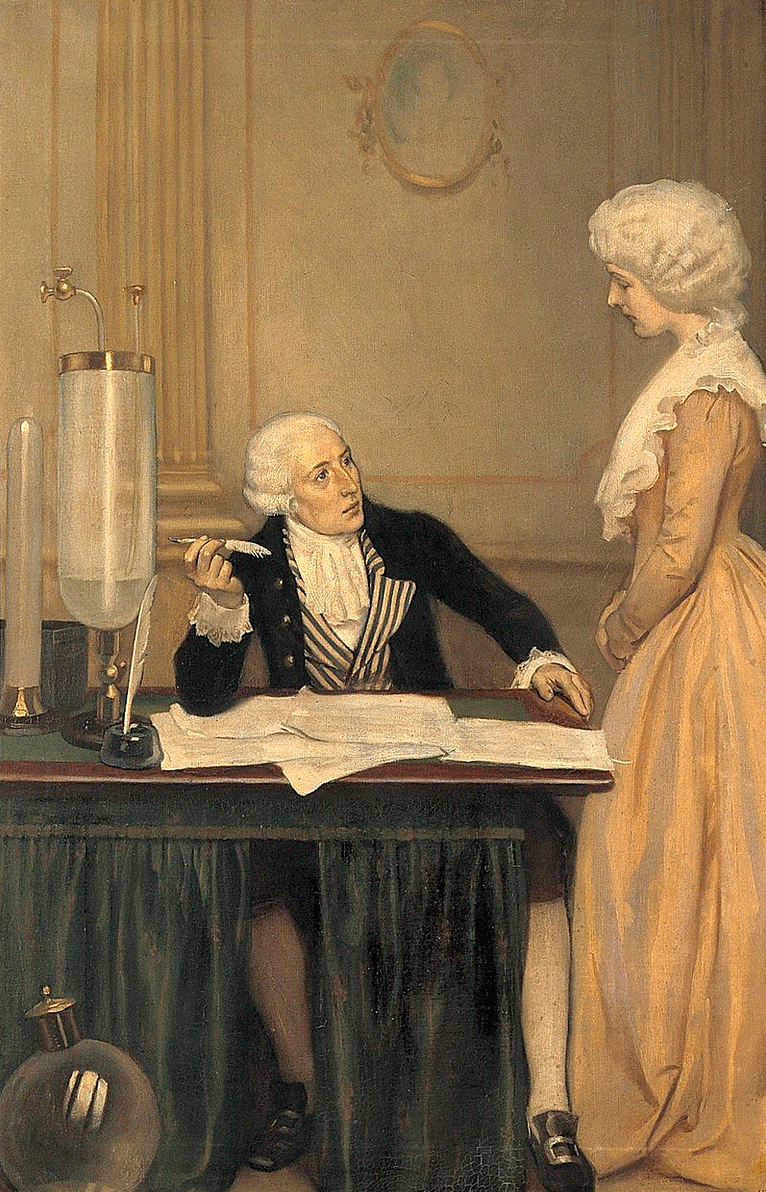
Antoine Lavoisier and his wife
(Wikipedia)
  The ensuing revolution in 1789 changed France and French medicine forever. Both Lavoisier and Bailly  perished under the guillotine. Dr. Guillotin was imprisoned but eventually released. The Marquis de Lafayette, another devotee, tried to introduce mesmerism to the U.S. but Thomas Jefferson opposed it and it never grew deep roots. The term “mesmerized” took on a milder connotation. Mesmer’s work, however, was a step toward the eventual recognition of the subconscious.

  
  SOURCES:
Darnton, Robert. Mesmerism and the End of the Enlightenment in France. 1968; Harvard Univ Press. 
Buranelli, Vincent. The Wizard from Vienna. 1975; Coward, McCann & Geoghegan.
Animal Magnetism: Report of Dr. Franklin and Other Commissioners (English Translation) 1837; H. Perkins, Philadelphia.
Huth, E J. “Benjamin Franklin’s Place in the History of Medicine”. 2006; James Lind Library Bulletin, available at: https://www.jameslindlibrary.org/articles/benjamin-franklins-1706-1790-place-in-the-history-of-medicine/
The International Journal of Clinical and Experimental Hypnosis, v 50 (4), 2002, devoted the entire issue to Franklin and Mesmer.
Lopez, C. “Franklin and Mesmer: An Encounter”. 1993; Yale J Biol Med 66: 325-31.